Sorry for the lack of posts from me, I went on vacation. I didn't build much over the summer, threw out some stuff at the end, but now I'm in school and the building is grinding to a halt. But, I have been working on the website! You may have noticed the header change here to better fit in with the main page. So check out http://masokotanga.unicornbreak.com to see the intro page that took me much longer than it should have! Both sections are up, however the extent of both is limited. The galleries all look fine for me, but apparently the font didn't embed because whenever I view a gallery on another computer all the writing is 'off'. Sigh. The Art section of the new website is sauntering along, the galleries there will be similar but different in presentation. Making a website is quite the frustrating project, and unlike the guys at Next-Gen Design I don't have Kepplah to code monkey for me. Also, watch 'The Fountain', buy the soundtrack, and die happy.
This post has been mulled over for a while, so I'm not going to give much of the average variety. No, today's update will run more like The Histories than any sort of review show. Today I'm going to look at my preferred topic, Microspace, in retrospect. A search on Lugnet of 'Micro' and 'Space' comes up with a few topics reaching back 11 years, with MOC topics showing up around 9 years and the first with pictures still accessible at 7 years ago. There's a topic from Jon Palmer talking with Mark Sandlin about what would become Zemi's SHIP Gallery (also 7 years ago), 6 years ago Bryce McGlone talks about a Japanese page of micro-mecha originally link to by a fellow by the name of David Perry - the page has since moved and my amazing ability to not understand the Japanese language leaves me to think said content is long gone.
This seems to be the main problem with looking this far back into the LEGO community's past without any real strategy or tangible sources; links dry up and folders are lost to the ages. However, one sees the names of those who are quite famous in the community today, Mladen talking about some micro-mecha, a link to a page once containing some works from Ken Takeuchi. I guess that is one problem of not being in community back then.
I think microspace has always been at least the hidden passion of some LEGO builders, the more popular solution is to build space ships in scale to Mini-figures, this gives a better sense of realism and allows for a pretty detailed interior - featuring spacemen. But somewhere, someone never has enough pieces to build their dream boat in scale to a mini-figure. What do you do? One way to realise the vision, at least partly, is to build it at a reduced scale. While I wouldn't say microscale was a bastard child of the space community (it was liked) it never garnered any glory or popularity until it's first mention on the Lugnet .Space Timeline: "Paul Baulch takes microfig scale to a whole new level". These are among my favourite all time LEGO creations, and the most inspiring: The Lance of Athena, and The Empyrean Flame. I think any space builder who knows which end of a drill bit to use knows at least one of those names and the creation behind it. Those two ships really gave microscale a name, and started a slow rise in microspace building. They were built a while ago if you judge it against a time-line of the community - against a time-line of LEGO, the revolution of more shaped slopes had come, though not to the extent we enjoy today. As it was, the Lance did something that few had really seen with any larger build (whatever scale it may be): it had shape. This wasn't your everyday box with decorations of Greebs and guns, this was the real deal. Both are huge, representing an enormous investment in parts seen most effectively in the repetition of numerous types of slopes. Both the Lance and the Flame are great milestones in Microspace, and though techniques may have improved you could argue that we've never really seen anything of their stature since.
Things become a little harder to trace in a timeline from here, I turn to the search engine on Classic-Space to see what comes up. There's a few results that talk about micro-gravity and renders, a few small ships by Sastrei, some of my own earlier attempts. Over all there's some interest in mircoscale but nothing monumental.
So the next great piece I found was the micro dioramas of Mark J. Stafford. Great because they were an entire setting of micro, one could see how different pieces interacted with each other and in turn create a better sense of scale between them all. The Octan Refinery does a few things: it shows us the great extent greebles can have on micro, they're not the same as greebs at minifig scale but work to convey more robust industrial workings of a ship (or anything else); it also shows the effective use that simple slopes can be put to to achieve shape. Baulch's big work showed this to some extent, but the size of his two more well known ships defeated this aspect.
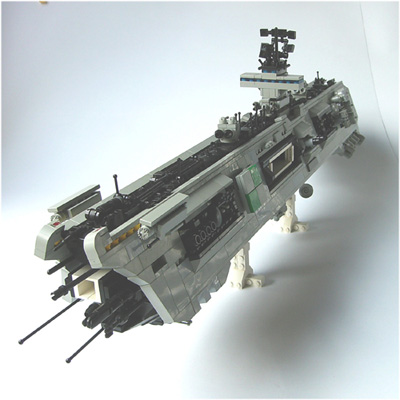
The refinery seems to have opened up a new can of Microscale, and the summer of 2006 is filled with wondrous creations from a plethora of builders: Peter Reid, and Justin Vaughn. It was about this time, spring '06, that I began to try and microscale in earnest. I'd been building for a few years now, but it wasn't until Mike Yoder came on the scene that I really wanted to try and be better. I think Mike said once that it was some of my microscale that helped inspire him to build microspace himself, so I felt obliged to try and offer some friendly competition when he floored me with his awesome building skills. The result of this was the Lancaster, the first in a series of three capital ships that were an on-going experiment for me. I feel like sometimes I build in stages, currently I'm trying to design civilian ships and see what space is like from a non-military view. When I built the Lancaster I was trying to build a capital ship - what does a ship need to be a flagship? It must be big, powerful, but must be a multi-role ship. But every ship needs to have some focus to it, otherwise it's slightly good at everything but very good at nothing. After the Lancaster was the Emperius, now with focus on a carrier and long range weaponry. It was still missing something, and I grasped for over half a year to find the right design. I was no longer sure what it was I was looking for however. Mike continued to kick ass, and the building genre was growing (and growing). When I finally pumped out the Eos, after I think seven separate attempted builds, I felt that I reached a milestone. The Eos itself was a pretty shapeless ship, and yet somehow I still admire its beauty - I achieved with it a great advancement in my skills concerning its individual parts, even if as a whole it was visually disengaging. But as I pushed my limits with larger ships, a new builder was experimenting with more manageable sizes: Spook. When I first saw Spook's microscale it was a little chunky and uninteresting, but his skills grew quickly and he soon surpassed me with both style and skill.
Microscale as a building genre was now quite established and diverse. Content that the style had picked up, I turned back to my own progression as a builder. I had achieved what I wanted in terms of technique, so I turned to experimenting with shape. I had quite a few stagnant ideas sitting around from my quest for the Eos, so I knew where to start. I wanted big guns, and classic style. This came together in the Argos, which of all my ships contains the most striking shape - especially for it's size. By now everyone was looking to try their hand at a microscale design, but it wasn't the typical fad bandwagon - it was a much slower build up and obviously is more open-ended than any fad. Lukas, J5N, not to mention Nnenn who had been building the scale for some time now. There was/is even talk about collaborating a microscale space base for conventions, along similar ideals of Moonbase; and rise of a special flickr group, one which breathes on a regular basis.
And there it is, a small history of Microspace. A little bias, and probably missing a lot, but there it is. The interesting thought I'd like to leave you with is this: What will the next generation write on this subject? Who will be remembered as doing what and what models in specific will earn respect as the time goes by. I'm sure there were more microspace builders back in Baulch's fame, but I wasn't there and now we see the things that get remembered.
This post has been mulled over for a while, so I'm not going to give much of the average variety. No, today's update will run more like The Histories than any sort of review show. Today I'm going to look at my preferred topic, Microspace, in retrospect. A search on Lugnet of 'Micro' and 'Space' comes up with a few topics reaching back 11 years, with MOC topics showing up around 9 years and the first with pictures still accessible at 7 years ago. There's a topic from Jon Palmer talking with Mark Sandlin about what would become Zemi's SHIP Gallery (also 7 years ago), 6 years ago Bryce McGlone talks about a Japanese page of micro-mecha originally link to by a fellow by the name of David Perry - the page has since moved and my amazing ability to not understand the Japanese language leaves me to think said content is long gone.
This seems to be the main problem with looking this far back into the LEGO community's past without any real strategy or tangible sources; links dry up and folders are lost to the ages. However, one sees the names of those who are quite famous in the community today, Mladen talking about some micro-mecha, a link to a page once containing some works from Ken Takeuchi. I guess that is one problem of not being in community back then.
I think microspace has always been at least the hidden passion of some LEGO builders, the more popular solution is to build space ships in scale to Mini-figures, this gives a better sense of realism and allows for a pretty detailed interior - featuring spacemen. But somewhere, someone never has enough pieces to build their dream boat in scale to a mini-figure. What do you do? One way to realise the vision, at least partly, is to build it at a reduced scale. While I wouldn't say microscale was a bastard child of the space community (it was liked) it never garnered any glory or popularity until it's first mention on the Lugnet .Space Timeline: "Paul Baulch takes microfig scale to a whole new level". These are among my favourite all time LEGO creations, and the most inspiring: The Lance of Athena, and The Empyrean Flame. I think any space builder who knows which end of a drill bit to use knows at least one of those names and the creation behind it. Those two ships really gave microscale a name, and started a slow rise in microspace building. They were built a while ago if you judge it against a time-line of the community - against a time-line of LEGO, the revolution of more shaped slopes had come, though not to the extent we enjoy today. As it was, the Lance did something that few had really seen with any larger build (whatever scale it may be): it had shape. This wasn't your everyday box with decorations of Greebs and guns, this was the real deal. Both are huge, representing an enormous investment in parts seen most effectively in the repetition of numerous types of slopes. Both the Lance and the Flame are great milestones in Microspace, and though techniques may have improved you could argue that we've never really seen anything of their stature since.
Things become a little harder to trace in a timeline from here, I turn to the search engine on Classic-Space to see what comes up. There's a few results that talk about micro-gravity and renders, a few small ships by Sastrei, some of my own earlier attempts. Over all there's some interest in mircoscale but nothing monumental.
So the next great piece I found was the micro dioramas of Mark J. Stafford. Great because they were an entire setting of micro, one could see how different pieces interacted with each other and in turn create a better sense of scale between them all. The Octan Refinery does a few things: it shows us the great extent greebles can have on micro, they're not the same as greebs at minifig scale but work to convey more robust industrial workings of a ship (or anything else); it also shows the effective use that simple slopes can be put to to achieve shape. Baulch's big work showed this to some extent, but the size of his two more well known ships defeated this aspect.
The refinery seems to have opened up a new can of Microscale, and the summer of 2006 is filled with wondrous creations from a plethora of builders: Peter Reid, and Justin Vaughn. It was about this time, spring '06, that I began to try and microscale in earnest. I'd been building for a few years now, but it wasn't until Mike Yoder came on the scene that I really wanted to try and be better. I think Mike said once that it was some of my microscale that helped inspire him to build microspace himself, so I felt obliged to try and offer some friendly competition when he floored me with his awesome building skills. The result of this was the Lancaster, the first in a series of three capital ships that were an on-going experiment for me. I feel like sometimes I build in stages, currently I'm trying to design civilian ships and see what space is like from a non-military view. When I built the Lancaster I was trying to build a capital ship - what does a ship need to be a flagship? It must be big, powerful, but must be a multi-role ship. But every ship needs to have some focus to it, otherwise it's slightly good at everything but very good at nothing. After the Lancaster was the Emperius, now with focus on a carrier and long range weaponry. It was still missing something, and I grasped for over half a year to find the right design. I was no longer sure what it was I was looking for however. Mike continued to kick ass, and the building genre was growing (and growing). When I finally pumped out the Eos, after I think seven separate attempted builds, I felt that I reached a milestone. The Eos itself was a pretty shapeless ship, and yet somehow I still admire its beauty - I achieved with it a great advancement in my skills concerning its individual parts, even if as a whole it was visually disengaging. But as I pushed my limits with larger ships, a new builder was experimenting with more manageable sizes: Spook. When I first saw Spook's microscale it was a little chunky and uninteresting, but his skills grew quickly and he soon surpassed me with both style and skill.
Microscale as a building genre was now quite established and diverse. Content that the style had picked up, I turned back to my own progression as a builder. I had achieved what I wanted in terms of technique, so I turned to experimenting with shape. I had quite a few stagnant ideas sitting around from my quest for the Eos, so I knew where to start. I wanted big guns, and classic style. This came together in the Argos, which of all my ships contains the most striking shape - especially for it's size. By now everyone was looking to try their hand at a microscale design, but it wasn't the typical fad bandwagon - it was a much slower build up and obviously is more open-ended than any fad. Lukas, J5N, not to mention Nnenn who had been building the scale for some time now. There was/is even talk about collaborating a microscale space base for conventions, along similar ideals of Moonbase; and rise of a special flickr group, one which breathes on a regular basis.
And there it is, a small history of Microspace. A little bias, and probably missing a lot, but there it is. The interesting thought I'd like to leave you with is this: What will the next generation write on this subject? Who will be remembered as doing what and what models in specific will earn respect as the time goes by. I'm sure there were more microspace builders back in Baulch's fame, but I wasn't there and now we see the things that get remembered.