Showing posts with label interview. Show all posts

Friday, 29 August 2008

The Hundred Days

Vive le Masoko Tanga! This blog has been defunct for quite sometime now, I was hit with school, work, something of a social life, and a general dim age has descended upon my hobby of LEGO building.  Tom may actually be dead. Well, who knows, perhaps he might strike at the flanks with a well prepared article. Enough talk, I move to the point of this post, and a most glorious point it is - to restore Masoko Tanga to its previous prestige!

Lukas, a Young Spacer who unlike myself still qualifies as a TFOL, has advanced his skills far passed what they were when he started building. I've known him loosely since he came to the Classic Space Forums - I've always been a relative outsider, and my inability to attend festivals will leave me to this fate more or less indefinitely.  I've always held Lukas in high regard, he never becomes egotistical about his skills, never lowers himself to blatant elitism, and generally tends to avoid internet drama - skills which seem to be lacking in the general Space community these days. So I sat down at my computer today and had an interview with him! I know he was recently interviewed by LAML, so I tried to ask questions that weren't of the basic and obvious variety.
 Now, in the last couple of years the demographics of the LEGO community have really changed. Back in 2003, you could refer to the online community as the AFOL community and it would make sense, the majority if not the entirety of the community at places like LUGnet were adults. 
"The starting group in toy chat rooms, LUGnet, and ultimately Classic-Space was started by men pretty much over the age of 30" says Lukas, "I think that the age demographic of the more intense LEGO community declined as time went on. ... along with a burst of internet activity, young people joined in". LEGO has and always will be targeted at the young audience, so its not as if the fans don't exist. By the time of LUGnet many younger fans were even online, as Bzpower is an example of, and smaller forums like Saber Scorpian's. But the group isn't the same as those, today there are many younger fans who show the same level of skill and effort that was previously only possessed by AFOLs. 
"We weren't aware of this more intense way of building until we were old enough to get on the internet and realize we could participate too". I think the last part there is ringing on a greater truth. At the start of my online excursions, settled into the Lego General section of Bzppower forums, I became aware of the AFOL .Space (who were not yet on Classic-Space); it never really occurred to be that I could join them, at least not at that stage in my building skills.
Lukas also came from a smaller community of younger builders, "I think it helped me ease into the serious building". There's a certain change that occurs in the mind of a LEGO fan when they discover a trove of people online who share the same passion, and another more significant change when that group is weeded out of those who will move on from LEGO once they pass the target age; "I realized how much people really cared and how much work other people put into the hobby".
There is also something to be said about coming from such a community and how it plays out upon a builder's skill and attitude, "if I had hopped right into Classic-Space, Classic-Castle, [or] the higher up forums it probably would have been more of a shock, and might have turned me away from the hobby". While harsh criticism is the best way to improve skills, sometimes it does a lot of good to be grounded with others around the same skill level.
"It also gave me a feeling that some people are very stuck up.... The high standards go both ways". There is often a thin line between tough love and though.  Sometimes the though love is needed, sometimes just the though, and other times neither. Its a situation that is dependent upon both sides as to what is needed. When I finally immigrated to Classic-Space forums I knew that I was going there for harsh and real criticism, of the kind you can't get there today. Such, I was not deterred when my first handful of models were largely dejected. Still, I was putting forth my best and hoping to make it better.
"People should put their best foot forth. ... the models that they have worked on the most and are most proud of" says Lukas, touching on the hierarchy of builders within the community, "some people reject all people who, while [they] might have incredible ideas or techniques, may not be able to make a spaceship with a consistent colour scheme". Luckily in my stay at Classic-Space there was no rejection of community members and I received the 'tough love' I needed.
"I still poke my head into both the higher-up and the lower forums, just so I can get the best view, I suppose".
Another recent change to the community was another migration. Just as many members left LUGnet and splintered into separate forums, many members are using flickr these days to host images of their creations and to interact with the LEGO community. 
"I still dislike thinking in terms of better and worse builders, but it does exists, and a forum where any builder, no matter how inexperienced [and] no matter how many years of grammar can join, things will go downhill eventually. This is one of the reasons why I enjoy flickr so much" that is, the ability to control who you are dealing with - while at the same time being part of a community with such a large pool of members, new and old.
"It makes it easier for new people to join, .... and with such a web of users, new people can quickly find experienced builders and learn from them". Whether or not flickr has the longevity that no other community site has achieved, remains to be seen, but it seems to incorporate a lot of features that people longed for in the sites of old.
We then moved to questions involving building. This blog has always had a soft spot for Microscale Space, so I kept the questions focused. Microscale has risen anew in the last couple years to heights of prestige never previously enjoyed. It seems like such a specific genre, but in fact it is the most open of any building style.
"Once you toss the minifig out the window really anything can be made.... it lets extraneous parts get unique uses and doesn't destroy my collection. It also allows for a myriad of unique shapes unrestricted by gravity or that pesky thing known as 'common sense'".
Why then did it take so long for Microscale to become an established and popular style? Before builders like Mike Yoder or Jerac came along, microscale was relatively obscure and the only models that enjoyed celebrity were those of Paul Baulch. 
"It just goes with the ebb and flow of building styles and fads. I feeling it fading a bit nowadays but that's fine. MICROSCALE WILL STRIKE AGAIN". Hah. Perhaps it has something to do with the fascination many AFOLs had during the LUGnet period with producing SHIPs. When you have enough parts to create big ships that fit with minifigs, microscale doesn't even begin to enter the equation. However, as mentioned earlier there was a great rise in the number of serious younger builders - who undoubtedly had much smaller collections than AFOLs and therefore couldn't produce SHIPs. 
I dared to dive into the builder's mind and clarify a few details about the thinking process that goes into creating a model.
"Generally when I get an idea it comes in shape form, then I decide whether that should be in microscale or minifig scale" he admits that occasionally this process is reversed. I know that I usually separate my scales and sit down with the intent of building in one particular scale. However sometimes there will be a shape or a configuration of parts that will get me thinking abstractly, and scale is left in lieu until I reach a part that grounds it.
"Depending on my collection and how some parts work out, details may change but for the most part I get my idea out there the way I wanted it to be.... if it doesn't end up the way I planned you don't see it" for the most part, he says. Working abstractly can be good, but it also can end with wasted time and effort.
I moved onto the final topic I wanted to question Lukas on, and that was the photography of LEGO models. Is it really so important to properly document your model?
"Immensely. Sure a poorly photographed but amazing model will get known eventually, [brickshelf user] kero40 for example, but good photography makes the model the star of the show, rather than your dirty laundry or the gritty background you chose, and that makes the model more appealing". There have been a few attempts to educate the masses how to do this simply, I know because I've written a few of them and hope to publish another here on MT soon, but perhaps education through suggestion isn't enough?
"A few contests of late have required decent photography, which I think is a good rule" and here I tend to agree. For the sake of the builder, nothing can compare to seeing a model in person, so good photography is very important in giving your viewer the best impression.
"Good photography should bring out the depth of the model, but when you can physically move yourself around it you get a better sense of where parts of the model are in relation to each other" this means that bad photography is going to seriously detract from a model and undermine it's success with the community as a whole.
So how does Lukas photograph?
"I toss a sheet of poster board up against something in natural sunlight. I own a nikon D40 DSLR camera which I take the pictures with and then I touch them up with Photoshop CS3". Now, not everyone has access to CS3, but I know many a good photographer who makes due with the plethora of free options floating around the internet.
With that we brought the interview to a close and Lukas left to attend to other business, but I hope this article has touched upon atleast one subject that has been the musing of your mind and that you'll continue to read as Masoko Tanga turns a new leaf and hopefully puts out many more such articles before she keels. 

Friday, 11 April 2008

Jupiter Jazz; Q&A with Nnenn

It's been a while since the last interview so here's a brand new one to sink your fangs into!

...
Tom: Well first of all thanks for your time Nnenn, we're glad to have you here at Masoko Tanga. Browsing through your creations one of the things that strikes me is that you're not afraid to experiment with colour schemes. I can see bright blues and oranges, lime greens and even some neon parts amongst many others. Do you have a way of picking a colour scheme? Just a random selection from parts lying around or a process much more complex?

Nnenn: My colour choices are a mixture of randomness and some level of expertise. I've taught enough college art courses to know that red/yellow/blue aren't the primary colors, browns/tans are mostly dark and pale oranges (so blue/teal compliments work well with them), colors are most intense at completely different values, etc. etc. But I'm also old enough to have seen color trends in fashion, design, art, or wherever, swing all over and come full circle; so there is a lot of subjectivity involved, it's really nothing more than current opinion. I always chuckle when I see someone comment about how 'those colors don't work.' So mostly, randomness can be effective... heck, rainbow schemes work if there is some intelligent hierarchy involved.

Tom: Are there any colours in the Lego parts-spectrum that you detest?

Nnenn: No colour, and few schemes, are detestable... so I don't mind rare Lego colours popping up, unless it's at the expense of something that could otherwise round-out a regular colour's part palette.

Tom: How much planning would you put into an average Moc? Do you rely on scribbled notebook sketches and L-Draw designs to test the waters or do you prefer to start out with just an idea in your head and a few bricks in your hand?

Nnenn: I almost never plan a model beforehand, though on rare occasions I'll do a 10-second sketch of something that pops into my head so I don't forget the basic shape. Mostly, I start with no more of an idea than 'large spaceship, fighter, mech, tank,' or whatever. Sometimes I just play with a few pieces to see if they can be arranged together into some fluid but dynamic form; I'm often surprised with the results (seriously)... I often think: 'wow, I couldn't have thought of that in a million years.' When teaching creativity, I usually stress working in the moment and letting go of preconceived notions; results that happen spontaneously are usually far more interesting that those that stem from careful plodding. However, notice most of my builds are not overly large... something that does, in fact, take a good deal of planning due to engineering considerations, time, parts, etc.

Tom: You've got a fair bit of theme-variety in your galleries but you're of course best known for your Space creations. Are there any themes that you've never built for that you'd like to experiment with in the future?

Nnenn: Although I enjoy the tangible process of connecting bricks at my whimsical discretion (read: playing with Lego), I am really fascinated with space themes in general. The combination of these interests seems ideal right now as I view both with limitless creative possibilities. But no, if I was restricted to building only themes like town, castle, steampunk, etc. I would probably sell my collection.

Tom: You mentioned ideas popping into your head, what builders inspire you?

Nnenn: Unusually perhaps, but the better builders don't really inspire me per-se, I note their technique and finish but their models are done well enough that my imagination sees little room for improvement. What gives me an immense amount of inspiration (and motivation) is seeing really poor, amateurish creations on Brickshelf.com. Kids don't have the conventional constraints that adult minds feel necessary; hence, all the really wacky designs out there that we instinctively scoff at... but if George Lucas, for example, were to add some polish and fly it through the right setting, suddenly it's totally believable.

Tom: Now you've gained much notoriety for not being afraid to experiment with clone bricks and other Non Lego items. What's perhaps the strangest Non-Lego item you've ever incorporated into a Moc?

Nnenn: I've always felt that rubber bands are really odd things to include in creations: they're tactilely opposite of bricks. But actually, there hasn't been anything really too strange... that's yet to come. I plan on building a big wooden frame to hold a really large ship; it saves me from having to deal with substructure engineering, something which I could not care less about, and focus on the aesthetic design. Lego does this sort of thing all the time but I'm sure a few 'dedicated purists' will be snippy about it.

Tom: And lastly, out of all your creations do have a favorite and for what reason?

Nnenn: I'm notorious among those that know me for not having favorites... for anything. But I usually feel whatever I'm currently working on is the most amazing thing ever, then after a few days (and pictures) later I look at it and wonder what I could have possibly been thinking... so I start something new to compensate.
...

Many thanks to Nnenn for the great interview! Nnenn's work can be viewed at either Brickshelf or Flickr whatever your fancy.
Now be sure to join us at the same bat-place and same bat-time next week when I'll be back to the usual irrelevant ramblings and communist propaganda that you've grown to love/ resent.

Wednesday, 20 June 2007

How We Operate

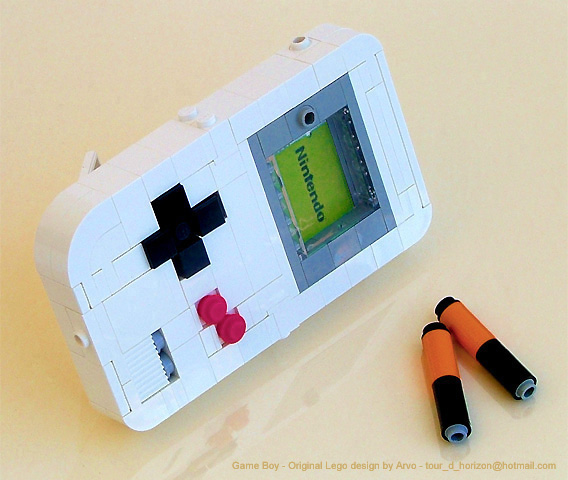
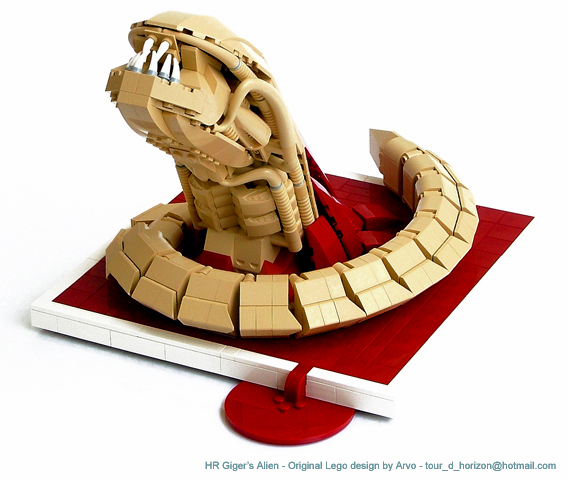
An article or two back I did a spotlight on an amazing Lego sculpturer who goes by the name of Arvo. Arvo, aka building brothers Ramón and Amador recently agreed to an interview for Masoko Tanga.
...

Tom:
Well first of all, Ramón & Amador thanks for your time and the interview. I've heard that you two guys are brothers, joint building partnerships like that are fairly uncommon in the Lego community as far as I know. How does that work out? Do you both work on the same model or do you both work on individual projects?

Ramón & Amador: Exactly, we are two brothers and we imagine that it is not a very usual case. But overall we are friends and we always have had the same interests, VideoGames, Films, LEGO, music. All our MOCS are done by both, we take the initiative from a suggestion, an idea or a recollection so that we both contribute ideas. For example; while my brother tries some technic in a certain part of a MOC I can suggest some modification or even to construct the modification, or construct in another zone. In the Ford GT each one constructed a different part, but always together in permanent communication. This is the most important aspect; communication. Even in the small MOCs this is our way. I remember when we did the "Headphones", four hands are too many hands in this cases but it is the only way of constructing that we know, to construct together is very fun.

Tom: Your models quite often have very intricate and complex designs. Before you guys start work on a Moc, do you plan the design out before-hand in anyway such as L-Draw or just quick pencil and pen sketchbook sketches?

Ramón & Amador: Each MOC has its own beginning, sometimes we begin with some sketches in LDraw. In this program we put parts together like a "puzzle". This program serves us to know if it is possible to obtain certain forms. We do not worry about joining the pieces inside the program, we are only interested in obtaining the form. Obtaining the form is the most difficult thing, to join these pieces it is only a problem of technic that is normally relatively easy to resolve. However, almost always we start by constructing directly with bricks.. on the bed!, the most comfortable place of the world to construct.. you can rest and play without moving of this place.. incredible! To construct directly with bricks is the fastest way, and the best way of knowing what pieces we will need. Anyway, before this, we obtain all the possible pics of the object that we want, we take measurements and concentrate on those more important details. This step is very important for us, although it is not always possible.

Tom: A lot of people have commented that your work looks like that of an engineer. Do you guys have any background in engineering or arts or similar fields?

Ramón & Amador: In fact we are engineers, we work in different companies but every day we join for a few hours to speak or to play LEGO. We suppose that this is related to our technic of constructing but not so much with our conception of the forms. Since our childhood we have been acquainted with the plastic arts thanks to the studio of painting and sculpture that our mother has always had. We were growing up and discovered music, the music is a perfect complement to the image. We dedicated years to make music for advertising which allowed us to accede to software design. Our first videoclips were made with LDraw. LEGO + Electronic music is a perfect combination.

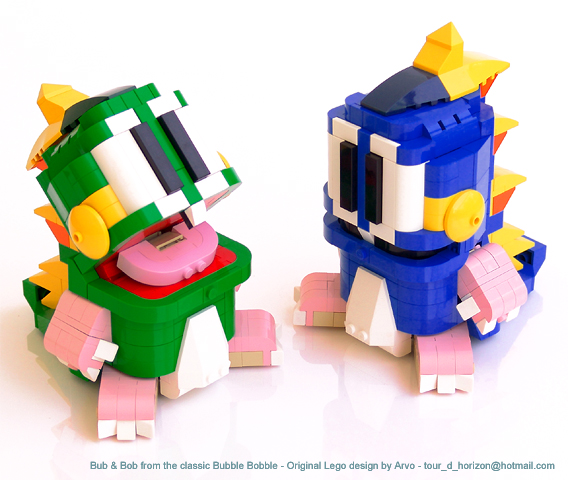
Tom: Looking at your B-Shelf gallery I see a lot of cars and a wide variety of creations from varying themes like Akira, video games and Alien. What kind of Mocs do you most enjoy building and is there anything in particular that you guys tend to draw a lot of inspiration from?

Ramón & Amador:
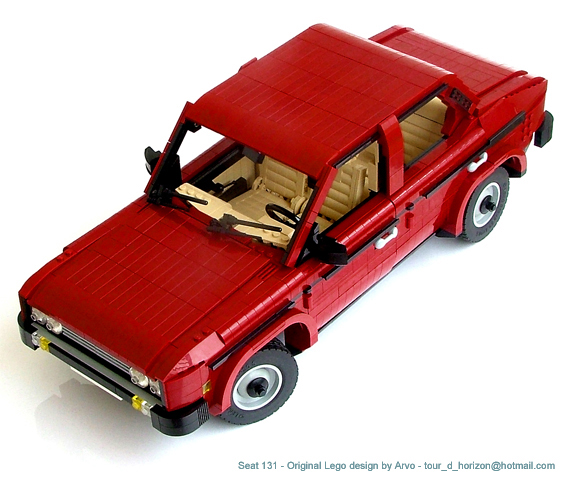
Yes, it's true. Although we feel very comfortable constructing vehicles (the references are in the street!) every time we feel the need to construct other things. All our references come from our childhood and adolescence. The Seat 131 of our mother, the Vespa P200 of our father, the typewriter of our sisters, all the 80 and 90's videogames, even some animation films and comics. Nowadays there are two projects in our mind, the first one is to continue the Alien theme with a sculpture of the adult Alien and the second one is to do a sculpture of Ironman, our favourite superhero. We are also studying to translate the human musculature into the LEGO-language to emulate it.. and we’ll probably start in a few weeks.
Meanwhile we continue making little MOCs. Really, smaller MOCs are more fun to construct!
...

Many thanks to Amador and Ramón for their time and for a very insightful interview! You can check out all of their creations right here on B-Shelf. Also thanks goes out to Mike who was the original owner of the Lego blog interview idea before I blatantly stole it for my own deviouse ends.